Nazi Book Burning
The Book ThiefNazi Book Burning is presented as one of Nazi Germany’s defining instruments of power: a public spectacle in which censorship becomes ceremony, hatred becomes entertainment, and written language is treated as something that must be physically destroyed. Yet the bonfire also produces an unintended counterforce. By burning books, the regime creates the conditions for Liesel Meminger’s book thievery, making the fire both an act of ideological control and the origin point of her resistance through reading.
Ideological and Material Setting
The narrative places book burning within a wider account of Nazi rule. Nazi Germany is described as resting on anti-Semitism, an overzealous leader, and a nation fed by hatred, but the account insists that these forces required a shared appetite for destruction to become materially effective. Germans are associated with burning shops, synagogues, Reichstag buildings, houses, personal possessions, murdered people, and books. The list deliberately places books among buildings, belongings, and human bodies, showing that literary censorship belongs to the same continuum of political violence rather than standing apart as a merely cultural policy.
The burning also depends on organized participation. In Molching, preparations for Hitler’s birthday include a parade, marching, music, singing, and a fire intended to honor the Führer, celebrate military victory, and mark Germany’s supposed liberation from the restraints imposed since the end of World War I. Nazi Party members gather fuel by going from door to door and asking residents for material that should be destroyed. The Molching Express calls for newspapers, posters, books, flags, and the propaganda of enemies to be delivered to the Nazi Party office on Munich Street. The campaign reaches Schiller Strasse as well, where the road marked by yellow stars is searched one last time for anything that can be burned in Hitler’s name.
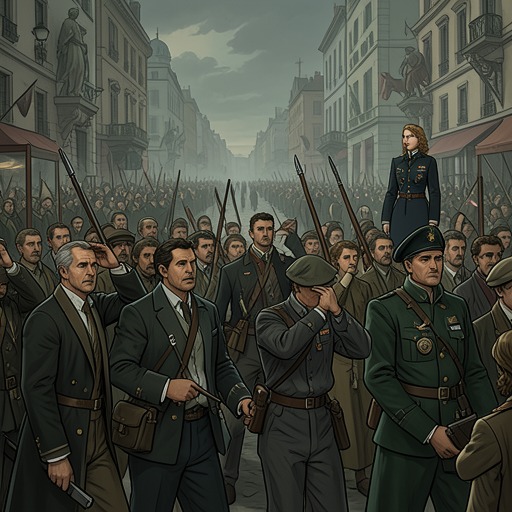
The public setting turns conformity into a visible obligation. On April 20, 1940, windows across Molching display Nazi flags. At Frau Diller’s house, the glass is scrubbed until the swastika shines; elsewhere, flags hang from ledges like laundry. Even the Hubermanns fear consequences when their own flag cannot be found, and it is eventually discovered behind Hans Hubermann’s accordion. At the ceremony, the crowd is surrounded by flags and uniforms, a speaker in a polished brown uniform demands silence, and his first words and action are the greeting and salute to Adolf Hitler. The crowd does not simply watch the spectacle: it breathes with it, sings its songs, and waits for its fire.
The Molching Bonfire
The decisive ritual begins when the speaker calls the books and other material “trash” and “poison.” A brownshirted official receives a torch, lights the mound, and repeats the salute to the Führer; the audience answers in unison. Other men surround the heap and ignite it from several sides while the crowd responds with approval, jokes, smiles, and repeated Nazi greetings. The scene’s social energy is important: destruction is not hidden in an office or carried out only by officials, but made into a communal celebration in which ordinary spectators are trained to experience ideological violence as pleasure.
The flames destroy more than paper. Orange fire waves over the crowd as print dissolves, and words are torn from their sentences. Beyond the heat, brownshirts and swastikas merge into a single field of uniforms and signs, so that individual people disappear into political symbols. The visual order of the scene is therefore one of absorption: language is broken apart, persons are reduced to emblems, and the crowd becomes an extension of the regime. The bonfire’s apparent unity conceals the violence required to produce it.
The event is also framed through an unusually self-conscious narration. The narrative interrupts its account of the crowd to refer to the forty million dead it has collected by the end of the story, then returns to the fire. This movement prevents the ceremony from closing into a self-contained historical pageant. The reader is repeatedly reminded that the spectacle’s immediate heat belongs to a much larger history of death, and that the narrator is actively shaping how the scene is seen rather than offering a neutral report.
Liesel Meminger and The Shoulder Shrug
For Liesel Meminger, the bonfire becomes personal when she recognizes what the ritual has gathered and what it excludes. She has already endured a starving mother, a missing father, and the death of her brother. The fire’s rhetoric of enemies and poison therefore collides with the grief and political language that structure her own memory. She is drawn toward the ash heap even after the crowd has gone. It appears magnetic and grotesque, and its pull is compared with the road of yellow stars: both are forbidden, charged spaces that she cannot stop looking at.
As men shovel the mound into a truck, a small section of living material emerges from within the ash. The surviving contents include half a red flag, two posters advertising a Jewish poet, three books, and a wooden sign bearing Hebrew writing. The objects have survived not because the fire has spared them intentionally, but because they were damp or buried too deeply for the flames to reach them completely. Their survival makes the pile an archive of what the regime attempted to erase, with Jewish identity and written culture emerging together from the remains.
Liesel reaches into the still-hot heap. The heat warms her, and on her first attempt it bites her hand; on the second, she moves quickly enough to seize the nearest book. The book is wet and burned only around its edges. Its blue cover is tightly textured, marked with red lettering and a small cuckoo bird; in the smoke, Liesel reads only the word “Shoulder.” The rescued volume is The Shoulder Shrug. The physical condition of the book records the encounter: it is damaged, hot, and nearly consumed, but not destroyed.
The theft is driven by more than curiosity. The book becomes Liesel’s second successful theft after she waits 463 days for the opportunity. The narrative describes her feeling not as shame but as pride, while anger and dark hatred have fueled her desire to take it. The contradiction is central: a regime that presents itself as morally cleansing creates an act of theft that feels, to Liesel, morally clarifying. The state calls books poisonous; Liesel’s act preserves one of the objects marked for destruction.
Consequences and Narrative Significance
The bonfire opens what the narrative calls the gates of thievery. Liesel’s second theft gives her a venue for continued book thievery and connects several later developments: it helps inspire Hans Hubermann’s plan to aid a Jewish fist fighter, and it establishes a chain in which one opportunity leads to another, risk leads to more risk, life to more life, and death to more death. The book is therefore not merely a possession. It is a material hinge between public Nazi violence, private rebellion, and the concealed acts of care that follow.
The event also establishes a pattern in which official labels and lived meanings diverge. Nazi Germany identifies books, Jewish writing, and the propaganda of enemies as objects to be eliminated, while Liesel sees the surviving volumes as irresistible. Her later identity as a thief is shaped by this conflict. Rudy Steiner eventually distinguishes her actions from the army’s seizure of people and property, arguing that true stealing is what the army does when it takes fathers. That contrast exposes the moral inversion at the center of Nazi Book Burning: the state claims legality and righteousness while practicing organized theft and destruction; the child called a thief preserves what power wants forgotten.
The fire’s consequences extend beyond the scene itself. The surviving book becomes part of Liesel’s developing relationship with words, while the memory of the burning remains bound to the larger history of Nazi persecution and war. The narrative later names her completed work The Book Thief, turning the title into a retrospective answer to the bonfire. What the flames attempted to silence becomes the material of a story. Nazi Book Burning thus fails in the most consequential sense: it can destroy pages, but its violence also creates witnesses, thieves, memories, and texts capable of carrying the erased voices forward.